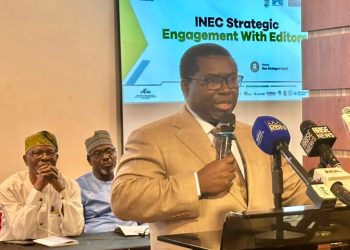


INEC, Political Parties Brainstorm on Regulations Ahead of 2027 General Elections
By Raphael Ekpang
The Independent National Electoral Commission (INEC) has convened a high-level consultative meeting with leaders of political parties to deliberate on the review of its Regulations and Guidelines for Political Parties, as part of ongoing efforts to strengthen Nigeria’s electoral framework ahead of the 2027 General Elections.
Addressing stakeholders at the Commission’s headquarters in Abuja, the Chairman of INEC, Professor Joash Amupitan, described the engagement as a critical step toward enhancing transparency, accountability, and credibility in the electoral process. He noted that the newly drafted 2026 Regulations and Guidelines have been comprehensively reviewed and aligned with the provisions of the Electoral Act 2026.
According to the INEC Chairman, the revised framework covers key areas including political party registration and mergers, party operations, conduct of primaries, campaign activities, election financing, and conditions for deregistration. He emphasised that the reforms are designed to address long-standing challenges such as opaque primaries, internal party disputes, and electoral litigation.
Prof. Amupitan further highlighted the Commission’s commitment to inclusivity, noting that the new guidelines incorporate measurable benchmarks to promote the participation of women, youth, and Persons with Disabilities (PWDs) in the political process.
He also drew attention to the compressed timeline for the 2027 elections, with Presidential and National Assembly polls scheduled for January 16, 2027, and Governorship and State Assembly elections set for February 6, 2027. He stressed the need for “surgical precision” in electoral preparations due to reduced timelines in the new Electoral Act.
In his remarks, the National Chairman of the Inter-Party Advisory Council (IPAC), Dr. Yusuf Mamman Dantalle, raised concerns over provisions in the Electoral Act 2026, describing the law as a regression that could undermine democratic gains if not urgently amended.
Dr. Dantalle called on the National Assembly to revisit the Act, particularly opposing the mandatory adoption of direct primaries and advocating for the restoration of indirect primaries to preserve the autonomy of political parties.
He also criticised the requirement for submission of party membership registers with National Identification Numbers (NIN) within a limited timeframe, warning that it could disenfranchise many Nigerians. Additionally, IPAC reiterated its demand for mandatory electronic transmission of election results and called for the establishment of an Electoral Offences Commission to strengthen accountability and curb vote buying.
The IPAC Chairman further urged INEC to demonstrate improved operational efficiency in upcoming off-cycle elections, including those in Ekiti and Osun States, particularly in the deployment of electoral technologies such as BVAS and the IReV portal.
Both INEC and political party leaders reaffirmed their commitment to sustained dialogue and collaboration to ensure a credible, transparent, and inclusive electoral process.
The meeting concluded with a call for constructive engagement by all stakeholders to refine the proposed regulations and safeguard Nigeria’s democratic future.