
2027: INEC, Correctional Renew Ties, Make Move to Register Over 50,000 Inmates
By Raphael Ekpang
Abuja (Core Reporters) The Independent National Electoral Commission (INEC) and the Nigerian Correctional Service (NCoS) on Friday, August 8, renewed ties with the view to fostering understanding towards getting inmates on awaiting trials get involved in the nation’s electoral processes, particularly the 2027 general elections. This, according to the two bodies will enable the inmates who have not been convicted by the court of law exercise their fundermental human rights of voting in an election as enshrined in the constitution of Nigeria, 1999 as amended.
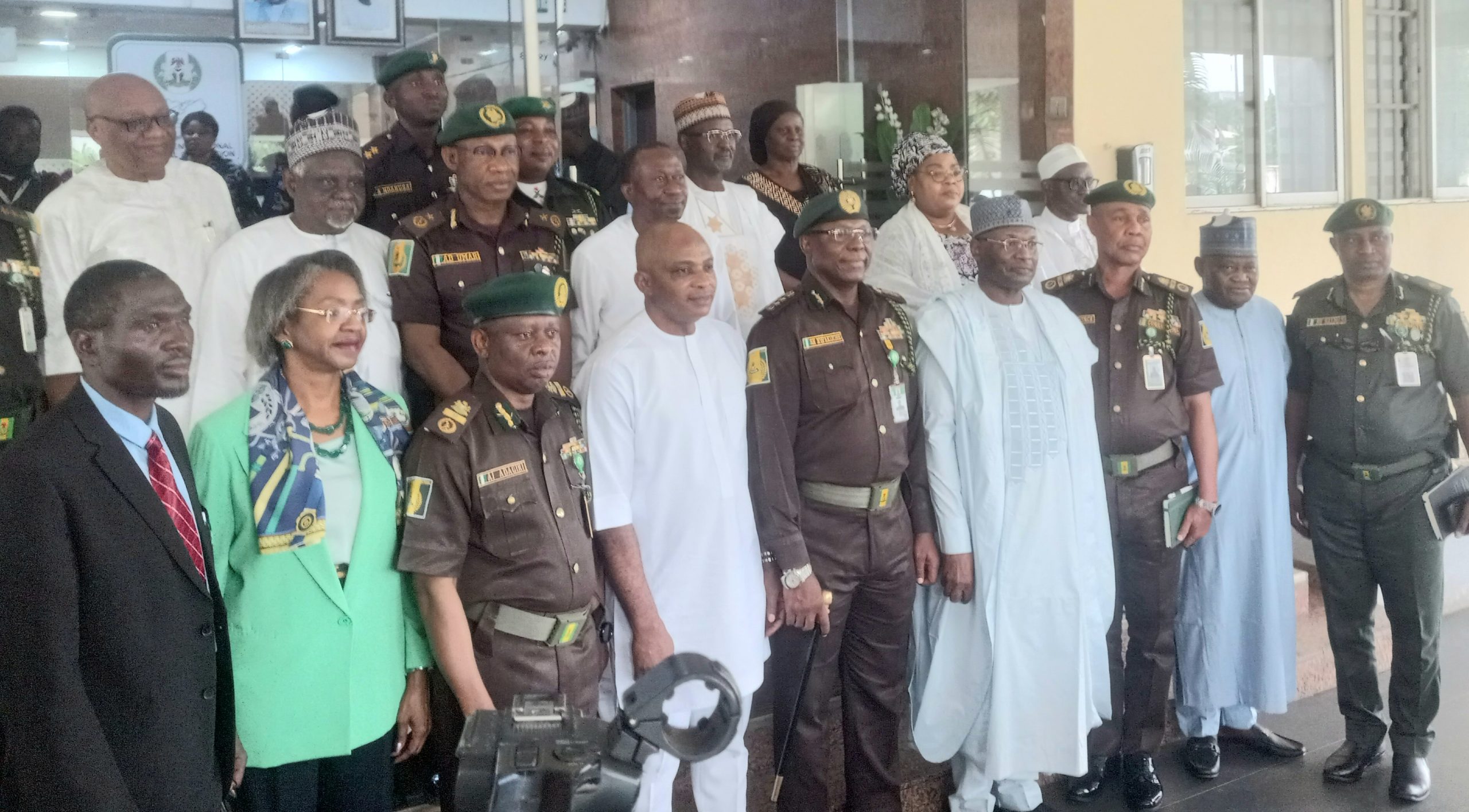
This was made known on Friday as the Comptroller-General (NCoS), Sylvester Mwakuche, and his team to paid a courtesy visit to the IINEC Chairman Prof. Mahmood Yakubu, at his office in Abuja. Both leaders noted that incarceration, especially for those awaiting trial, should not erase a citizen’s constitutional right to vote.
The INEC boss while speaking before his guests referenced a 2014 Federal High Court judgment and a 2018 Court of Appeal ruling in Benin, both affirming the voting rights of awaiting trial inmates.
“The Commission is aware of the judgments of the Federal High Court in Benin, delivered on 16th December 2014, and the Court of Appeal also in Benin, delivered on 7th December 2018, pertaining to the right to vote by five plaintiffs awaiting trial. Based on the combined provisions of Article 25 of the International Convention on Civil and Political Rights 1966 and Section 25 of the Constitution of the Federal Republic of Nigeria 1999 as amended on citizenship, the Court affirmed the rights of the plaintiffs who were inmates awaiting trial to vote in elections. However, the judges in the two judgments ruled that the right to vote is only excisable when asserted, as it is a choice to be exercised voluntarily by a citizen and not a duty to be imposed by a force of authority.”
He revealed further that a joint INEC–NCoS Committee had already begun mapping out the logistics for inmate voting, including access for voter registration, creation of polling units inside facilities, voter education, and mechanisms for political party agents, election observers, and the media to ensure transparency.
According to him, political parties, election observers, and the media would need access to correctional centres to ensure transparency, while campaigns and polling agent deployment must be addressed in the process.
Yakubu also urged lawmakers to provide explicit legal backing in the ongoing electoral reforms, warning that Section 12(1)(e) of the Electoral Act 2022 leaves room for conflicting interpretations.
“Again, working together, we can seize the opportunity of the ongoing electoral reform for a clear legal provision that will specifically cover citizens serving time in our correctional facilities. Doing so will clarify the provision of Section 12, subsection 1E of the Electoral Act 2022 on voter registration, a precondition for voting in elections, which is restricted at the moment to Nigerian citizens who are not subject to any legal incapacity to vote under any law, rule, or regulation enforced in Nigeria. There are various interpretations as to whether this provision relates to inmates on death row, or those serving life sentences, or those convicted for treason.
“Our immediate task is to engage the National Assembly for a clear legal provision on inmate voting. Thereafter, we can address the specific issues that may arise in the course of implementation. On this note, the Commission appreciates the role of civil society organizations that have interfaced with both INEC and the Correctional Service in their consistent advocacy for inmate voting in Nigeria,” INEC boss said.
Earlier in his address, CG MCoS, Sylvester Mwakuche, made a direct appeal for urgent action, insisting that inmate voting is not a privilege but a constitutional guarantee.
He said, “Even while in custody, inmates remain citizens of this great nation. The mere fact that they are incarcerated should not deny them the right to vote,” he said, noting that the National Assembly had recently passed a resolution in support of inmate voting.
The NCoS Boss argued that the reform would not only uphold fundamental rights but also strengthen public trust in Nigeria’s democracy.
The MCoS boss address indicated that about 81,000 inmates are in Nigerian correctional centres, and two-thirds of whom are awaiting trial, therefore, both leaders stressed that denying them the vote contradicts constitutional provisions, court rulings, and global democratic norms.
“The right to vote is a human right that cannot be taken away simply because a citizen is serving time in a correctional facility,” Prof. Yakubu declared, citing Ghana, Kenya, and South Africa as examples where inmates participate in national elections.
Both institutions pledged to intensify collaboration with civil society groups like the Carmelite Prisoners’ Interest Organization (CAPIO) and work closely with the National Assembly’s Joint Committee on Electoral Matters to make inmate voting a reality, possibly in time for the 2027 general elections.
Core Reporters report that If implemented, the policy could set a new precedent in Nigeria’s democratic evolution, making the ballot box accessible to one of the country’s most overlooked populations.