
Nyanya-Kugbo Road: The Valley of Death
By Raphael Ekpang
There is no evidence that David the Psalmist ever set foot in Abuja, Nigeria’s Federal Capital Territory, but his words in Psalm 23 resonate deeply with commuters who traverse the notorious Nyanya-Kugbo Road daily. It is also obvious no biblical character ever walked the dusty corridors of Nigeria’s FCT or has been recorded to have had anything to do with the most populous black nation in the world. Yet, for thousands of commuters who pass through that stretch daily, the words of Psalm 23 “Yea, though I walk through the valley of the shadow of death…” feel less like poetry and more like prophecy:
Located between AYA and Nyanya, this road has earned a reputation for danger, claiming lives and instilling fear in those who travel it. The stretch connects Abuja’s city center to populated satellite communities like Karu, Mararaba, and Masaka, making it a vital artery for commerce and daily life.
It also connects Nasarawa state and other parts of the North East, South South and South East states.
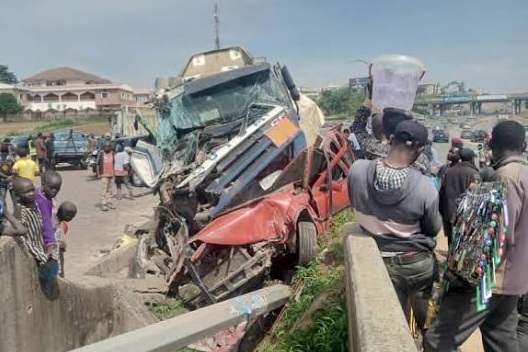
However, the road’s importance belies its deadly reputation. Multiple-vehicle accidents, often caused by brake failure in heavy-duty trucks, have become alarmingly common. The consequences are devastating: fatalities, injuries, and a pervasive sense of anxiety among commuters.
“Every morning, the road comes alive with movement—workers rushing into the city, traders transporting goods, students heading to school, and families chasing daily survival,” says Nicholas Adams, a commercial motorcyclist. “But alongside this movement is a darker presence: fear.”
The causes of these accidents are predictable: narrow lanes overwhelmed by traffic, reckless driving, broken-down vehicles, poor lighting, and inadequate traffic control. The Federal Road Safety Corps (FRSC) and the FCT Police Command have issued advisories, urging motorists to maintain their vehicles and follow traffic regulations.
Yet, the pleas continue. “We appeal to the government to please do something about it,” Adams says. “Too many lives have been lost to these trailer drivers’ recklessness.”
“We are aware that the current minister of FCT, Nyesom Wike is “Mr Project” we are pleading with him in collaboration with the minister of Works, Dave Umahi to help work on this blood testing portion of the road–many have gone and more will still go if nothing urgently is done about it during their time in this strategic positions.”
The road’s dangers are not limited to accidents. Insecurity is a constant threat, with reports of one-chance robberies, roadside theft, and harassment.
“It’s not just the accidents; it’s the fear of being attacked,” says a commuter. “You can’t help but feel anxious every time you travel this road.”
The Nyanya-Kugbo Road is a stark reminder of Nigeria’s infrastructure challenges. Its transformation requires urgent attention: expanded road capacity, functional pedestrian bridges, better lighting, and stronger traffic enforcement.
Its worthy to note that Abuja is a city designed to represent national pride, but this road reflects national failure.
David may never have known Nyanya. He never saw Kugbo. He never sat in Abuja traffic or faced the desperation of an overburdened transport system. But his ancient words echo loudly here.
The valley he described was spiritual. Nyanya–Kugbo is physical. It is a place where people walk not with assurance, but with anxiety. Where commuters whisper prayers before journeys. Where parents worry when children are late. Where transport workers accept danger as part of the job.
It is not the shadow of death alone. Death itself has visited too often. A Road That Deserves Redemption It does not have to be this way.
Nyanya–Kugbo Road is not cursed by nature. Its dangers are man-made, born from years of inadequate planning, delayed infrastructure, weak enforcement, and rapid urban expansion.
Solutions are not impossible: Expanded road capacity, Functional pedestrian bridges, Better lighting and surveillance, Stronger traffic enforcement, Emergency response presence and Proper maintenance culture but what is missing is urgency.
Beyond Metaphor: A Call for Action Nyanya–Kugbo is more than asphalt. It is the lifeline of thousands. It is a daily route of hope for people chasing livelihoods in the capital city. To allow it to remain a valley of death is to normalize tragedy.
Never the less, as David’s Psalm offers comfort, commuters on this road yearn for a more immediate reprieve—safe passage home. It’s time to reclaim the Nyanya-Kugbo Road from the valley of death and transform it into a corridor of safety and dignity.