Deprecated: Function WP_Dependencies->add_data() was called with an argument that is deprecated since version 6.9.0! IE conditional comments are ignored by all supported browsers. in /home/corerepo/public_html/wp-includes/functions.php on line 6260 Reform Scorecard: FG Explains How Subsidy Removal Saved Nigeria ₦15.8trn - Core Reporters
Reform Scorecard: FG Explains How Subsidy Removal Saved Nigeria ₦15.8trn
By Sarah Kitka
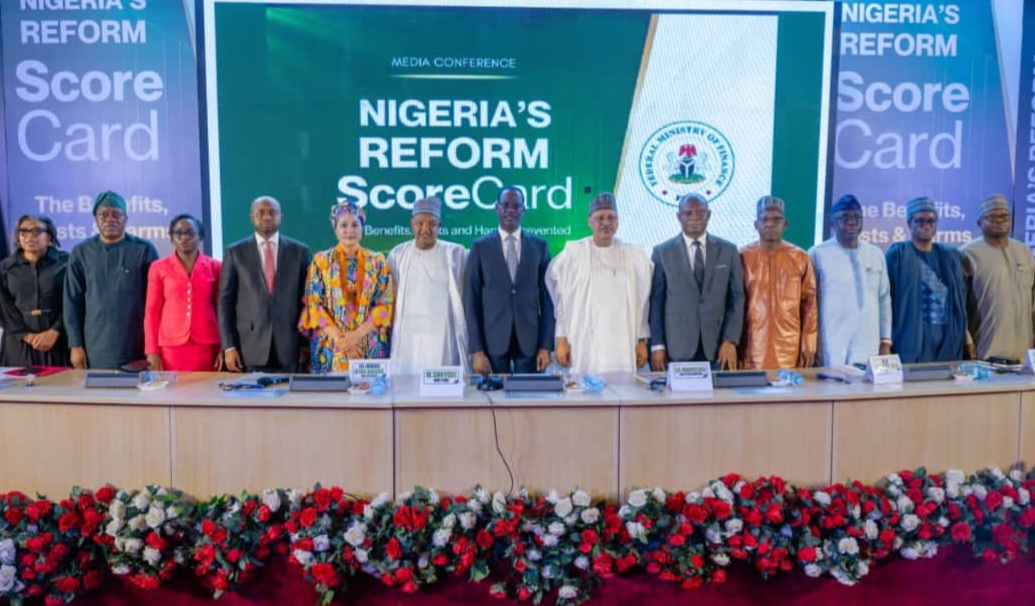
Abuja (Core Reporters) — The Federal Government has presented Nigeria’s Reform Scorecard: The Benefits, Costs & Harm Prevented, highlighting the impact of the economic reforms undertaken by the administration of President Bola Ahmed Tinubu.
The scorecard was presented on Wednesday in Abuja at an event hosted by the Federal Ministry of Finance and attended by key members of the Federal Government’s economic management team and senior government officials.
Presenting the score card, the Minister of Finance and Coordinating Minister of the Economy, Taiwo Oyedele, explained the benefits and costs of the reforms, as well as the potential economic harm the government said had been prevented through the measures.
Oyedele said the removal of petrol subsidy and unification of the foreign exchange market generated ₦15.8 trillion in savings for the Federation between June 2023 and December 2025, while helping Nigeria avoid a deeper fiscal and economic crisis.
According to Oyedele, the subsidy savings comprised ₦5.4 trillion accruing to the Federal Government and ₦10.4 trillion shared among states and local governments. The Federal Government also generated ₦3.1 trillion in additional independent revenue, mainly through remittances from government-owned entities, while incremental borrowing contributed ₦11.9 trillion.
He said the Federal Government’s total incremental resources during the period stood at ₦20.4 trillion, contributing to additional expenditure of ₦30.64 trillion.
The minister explained that ₦9.39 trillion was spent on wage adjustments, minimum wage increases and allowances, while ₦9.37 trillion went towards external debt servicing resulting from exchange-rate depreciation. Another ₦6.5 trillion was committed to strategic infrastructure.
Oyedele said 58 per cent of the government’s incremental resources came from borrowing, 27 per cent from subsidy savings and 15 per cent from other revenue.
He stressed that the reforms were not introduced primarily to raise government revenue, but to address corruption, arbitrage and distortions associated with the former petrol subsidy regime and multiple foreign exchange windows.
The scorecard assessed 25 indicators covering fiscal sustainability, external stability, investment climate, social impact, and growth and productivity. Oyedele said all 36 states can now reliably meet salary obligations, compared with 27 states struggling to do so in May 2023. Without the reforms, the government estimated that at least 30 states could have faced difficulties paying salaries by 2026.
He also said the gap between official and parallel exchange rates had fallen from above 60 per cent before the reforms to below five per cent, compared with a projected possibility of exceeding 150 per cent under the previous system.
The Minister of Information and National Orientation, Mohammed Idris, in his welcome address said the reforms remained necessary to strengthen Nigeria’s fiscal position, improve economic stability, and create the resources required to fund critical sectors of the economy.
Meanwhile, the scorecard presentation provided an assessment of the government’s reform measures, including their implications for public finances, revenue mobilisation, debt management, economic growth, and citizens’ welfare.
It also brought together senior officials responsible for the country’s fiscal, monetary, revenue, statistical, and budgetary management.
Among those present were the Minister of Budget and Economic Planning, Abubakar Atiku Bagudu; Minister of State for Finance, Dr Doris Nkiruka Uzoka-Anite; Director-General of the Debt Management Office, Patience Oniha; Statistician-General of the Federation, Prince Semiu Adeyemi Adeniran; Executive Chairman of the Nigeria Revenue Service, Dr Zacch Adedeji; and Director-General of the Budget Office of the Federation, Tanimu Yakubu.
Others were the Permanent Secretary, Federal Ministry of Budget and Economic Planning, Dr Deborah Bako Odoh; Permanent Secretary, Federal Ministry of Finance, Raymond Omenka Omachi; Permanent Secretary, Policy Support and Special Duties, Federal Ministry of Finance, Mohammed Sanusi Danjuma; Accountant-General of the Federation, Shamseldeen Babatunde Ogunjimi; and Director-General of the National Orientation Agency, Mallam Lanre Issa-Onilu.
The Federal Government said the scorecard was intended to provide Nigerians with a clear assessment of the reforms, including the sacrifices and adjustments they have required, while demonstrating the benefits and economic challenges they have helped to avert.
The presentation forms part of the government’s continued effort to communicate its economic policies and provide greater transparency in the management of public resources.