
Agency Report
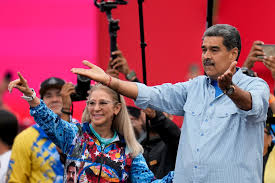
Venezuela’s rulling party maybe facing serious electoral test after decades in the helm of the country ‘s affairs going into Sunday’s presidential election which could give President Nicolas Maduro another six years in power, or end the self-described socialist policies that once successfully boosted anti-poverty programs but whose sustained mismanagement later pushed the country into an ongoing economic crisis.
For years, opposition politicians boycotted elections they saw as rigged, but as the government’s popularity has ebbed former rivals have banded together in an attempt to change the government at the ballot box.
“No one is going to create chaos in Venezuela,” Maduro said after voting. “I recognize and will recognize the electoral referee, the official announcements and I will make sure they are recognized.”
He called on the other nine candidates “to respect, to make respected and to declare publicly that they will respect the official announcement” of the winner.
The prolonged economic and political instability in Venezuela has forced millions of Venezuelans to leave over the past decade, quashing many of their dreams and leaving many wondering if they’ll ever return to what was once South America’s most prosperous country.
The refugee agency UNHCR estimates that more than 7.7 million Venezuelans have left since 2014, the largest exodus in Latin America’s recent history, with most settling in the Americas, from neighboring Colombia and Brazil to Argentina and Canada.
“It is not just about changing the president,” said María Auxiliadora Añez, a 60-year-old Venezuelan living in Colombia. “We need quality of life, access to basic and essential services such as water and electricity
Edmundo González Urrutia began his career as an aide to Venezuela’s ambassador in the U.S. in the late 1970s. He had postings in Belgium and El Salvador and served as Caracas’ ambassador to Algeria.
His last post was as ambassador to Argentina during the first years of the presidency of Hugo Chávez, who came to power in 1999. Chávez transformed Venezuela with socialist policies like nationalizing industries and launching welfare programs. Chávez handpicked Maduro to replace him before dying of cancer in 2013.
More recently, González worked as an international relations consultant and wrote a historical work on Venezuela during World War II
Source (AP News)