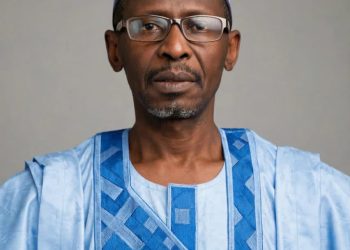

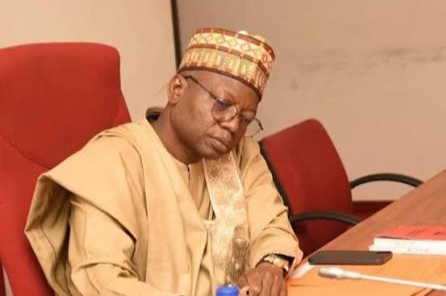
Senator Mohammed Sani Musa: A Statesman Mending the Fabric of Niger East and Beyond*
By Adamu Adamu
Senator Mohammed Sani Musa, fondly called “Senator 313” in many quarters, is one of the few public servants whose names are spoken with casual familiarity and mentioned as one of the rare statesmen whose footprints on the soil of their constituency read like a map of care, competence, and custodianship. His political persona is not a mere parade of campaign rhetoric but an architecture of visible interventions: boreholes that bring water to the thirsty, vocational centres that resurrect hope for young people, rehabilitated clinics that restore dignity to the sick, and targeted empowerment programmes that seed economic agency in households.
To know Senator Sani Musa is to see how a legislator can transpose empathy into policy and philanthropy into long-term community transformation. Born on 11 May 1965 in Minna, Niger State, Musa’s formative years traversed local schools before he entered the portals of advanced management training and public-leadership programmes.
He studied Business Administration, Banking and Finance at Ahmadu Bello University and subsequently sharpened his strategic and leadership repertoire at prestigious international institutions—a trajectory that later coloured his public-sector finesse when he served as Special Adviser on Investment and Infrastructure to the Niger State Governor. That professional past is not ornamental; it explains why his interventions are invariably well-targeted and sustainable rather than performative.
From the vantage point of Niger East, and at the very heart of the senatorial district he represents, Musa’s style of governance is a deliberate service-delivery template. The architecture of that template is unmistakably woven into infrastructure for daily life, healthcare bolstering, education investments, targeted youth empowerment, and decisive legislative stewardship at the national level.
Consider the priority areas of his work: he facilitated the construction of two 50-bed hospitals—one in Sarkin Pawa, Munya LGA, and the other in Kuta, Shiroro LGA. In fulfilling his promises to his constituency, he launched an inclusive empowerment programme from which 500 women and youths benefited.
The programme provided 21 tricycles for transportation and small-scale business, 130 motorcycles for commercial use, 80 grinding machines for food processing, 80 deep freezers for preserving perishable goods, 30 generators for reliable power supply, and 95 sewing machines for tailoring and fashion design. He also distributed 4,050 bags of fertiliser—1,000 urea and 3,050 NPK—across the nine local government areas to boost agricultural productivity.
Moreover, in a remarkable show of generosity, Senator Musa disbursed ₦143 million to 2,868 constituents, with each receiving ₦50,000. Additionally, he launched a fully funded international scholarship programme, enabling 100 academically gifted students to study medicine in India and another 100 to pursue engineering, artificial intelligence, and robotics in China.
The Senator has also made multiple interventions in education: settling registration fees for undergraduate students, paying NECO and JAMB fees, and extending educational assistance to 1,000 higher-institution students across his constituency.
What distinguishes Musa’s political philanthropy is the philosophy behind it: the conviction that government ought to repair the everyday ruptures in citizens’ lives. Water, power, health, and livelihoods—these are not glamorous headlines but the quiet scaffolds of human flourishing.
In villages across the nine local government areas of Niger East, his team has installed solar-powered boreholes and rehabilitated rural roads; they have worked to electrify clinics with solar power and supplied transformers and streetlights to market centres. Children who once missed evening studies because of darkness can now read under solar streetlights; clinics that could not store vaccines because of frequent outages now maintain unbroken cold chains thanks to solar installations.
The cumulative effect of such measures is a subtle yet decisive reweaving of social normalcy. As a member of the Senate in Nigeria’s 10th National Assembly, and having at various points held leadership roles on financial and budget-oversight committees, Senator Sani Musa writes legislation with a practitioner’s sensibility.
His parliamentary focus mirrors his ground-level priorities: appropriations that favour infrastructural renewal, oversight that insists on functionality rather than box-ticking, and sponsorship of bills that aim to institutionalise development gains for his constituency and the nation.
The cultural essence of Musa’s philanthropy is both deeply local and forward-looking. On one hand, he understands the rhythms of Nigerien communal life—how a repaired market road reverberates across livelihoods, how a vocational training centre can arrest the slide of young men and women from hope into crime.
On the other, Senator Musa’s political narrative is remarkable for its resilience. He is a man who has faced multiple electoral contestations, yet his re-election and continued public presence have positioned him as a politician whose legitimacy is grounded in visible delivery rather than mere rhetoric.
At the national level, Musa’s posture is that of a reconciler—a senator who understands the centrifugal forces pulling at Nigeria’s polity and who argues for the centripetal glue of competence-driven governance. In the Senate, where posturing can too easily eclipse policy, he is known as a lawmaker who prefers the painstaking work of committee deliberations, budget scrutiny, and legislative sponsorship. His tenure in financial-oversight roles proves his practical commitment to accountability, ensuring public resources are accounted for and budgets aligned to human needs rather than vanity projects. This posture is not merely technocratic; it is profoundly moral.
True, infrastructural deficits remain, and there is always more to be done to address the systemic causes of underdevelopment in parts of Niger and across Nigeria. Yet what distinguishes the senator from many of his peers is a demonstrable pattern: when problems are identified, he mobilises resources and follows through; when crises arrive, he responds; and when people are marginalised, he finds ways to extend assistance.
That pattern matters because politics is an ensemble of patterns, not singular events. Indeed, Musa’s blend of philanthropic disposition and institutional engagement is a template other lawmakers could emulate—not merely for Niger East but for a Nigeria hungry for leaders who can pragmatically transform the quotidian realities of millions.
To call Senator Mohammed Sani Musa a “philanthropic politician” is both accurate and insufficient. The better description is statesman-philanthropist: one who combines the soft virtues of care and proximity with the hard virtues of systems thinking and institutional stewardship. He is tender where politics demands tenderness—in healthcare corridors and market squares—and rigorous where governance demands rigour—in committee rooms and budget halls.
For the people of Niger East, he has been more than an occasional benefactor; he has been a consistent advocate of possibility. For Nigerians seeking a politics that returns to the essentials of service, Senator Musa is a voice and a record worth listening to—and learning from.
Adamu Adamu, a Teacher, writes from FUT, Minna, can be reached via adamudouble2000gmail.com*