

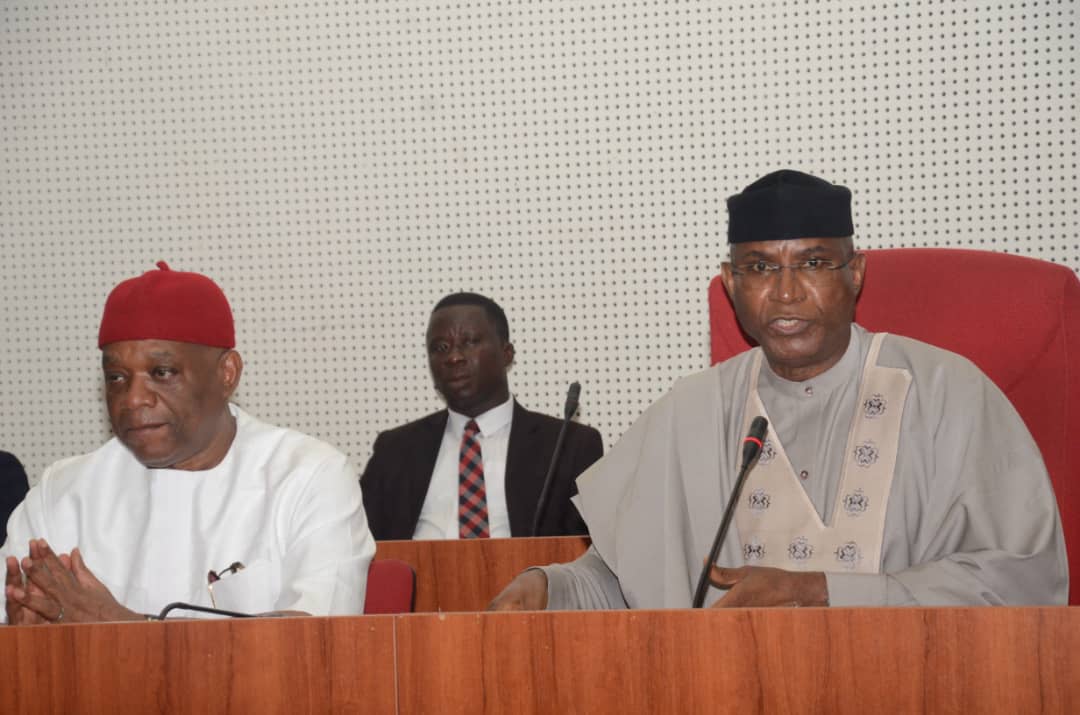

By Raphael Ekpang
The joint committee of the Senate and House of Representatives on the constitution review committee has approved and transmitted the Local Government Financial Autonomy Bill and 43 others to the 36 State House of Assembly.
Chairman of the joint committee, Senator Ovie Omo-Agege (Deputy President of the Senate) made this known on Tuesday while briefing newsmen on the progress of the committee on the constitution amendment.
He said, after several meetings and engagements with the State Houses of Assembly, the Joint Committee of the Senate and the House of Representatives recommended 66 Constitution Alteration Bills for passage.
Consequently, the committee considered that those 66 bills have a considerable level of national consensus as garnered from public consultations. And out of the 66 Bills, 44 were approved by both chambers.
According to him, “Subsequently, the 44 Bills were transmitted to the 36 State House of Assembly on 29th March 2022 for approval in line with Section 9(2) stipulations of the Constitution.

“The 44 Bills transmitted to the State Houses of Assembly seek to, amongst others: strengthen the legislature’s authority to enable it to serve as an effective pillar of checks and balance to the executive; strengthen independent constitutional bodies; create and strengthen a culture of good governance; address issues of revenue leakages and unbridled government spending, and enhance effective administration of justice in Nigeria,” he said.
The 44 Bills approved and transmitted to the 36 State House of Assembly by joint committee of the Senate and House of Representatives include; Local Government Financial Autonomy, Local Government Administrative Autonomy, Inauguration of Senators and Members Elect and Fair Hearing in the Process of Recommending the Removal of Judicial Officers. Others include; Devolution of Powers, Power to Enforce Compliance of Remittance of Accruals into the Federation Account and Review of Revenue Allocation Formula, Timeframe for the Submission of the Names of Ministerial or Commissioner Nominees, Establishment of State Security Council, Power to Summon the President and Governors, Creation of the Office of the Accountant General of the Federal Government, Separation of the Office of the Attorney General of the Federation and the State from the Office of the Minister or Commissioner for Justice and Independent Candidacy among others.However, the committee chairman Senator Omo-Agege expressed the committee disappointment on the level of compliance by state assemblies after six months of transmitting the bills
“Now, let us give you a sense of where we are with the Bills as of today (Tuesday). Six months after the transmission of these Bills to State Assemblies, it is most disheartening to inform you that only 11 State Houses of Asse