

Power Minister Tegbe Advocates Sustainable Financing for Nigeria Power for Health Initiative
By Raphael Ekpang
The Minister of Power, Adebayo Joseph Tegbe, has called on local and international investors to embrace sustainable financing models for the electrification of Nigeria’s healthcare facilities, describing the sector as one of the most compelling investment opportunities in Africa.
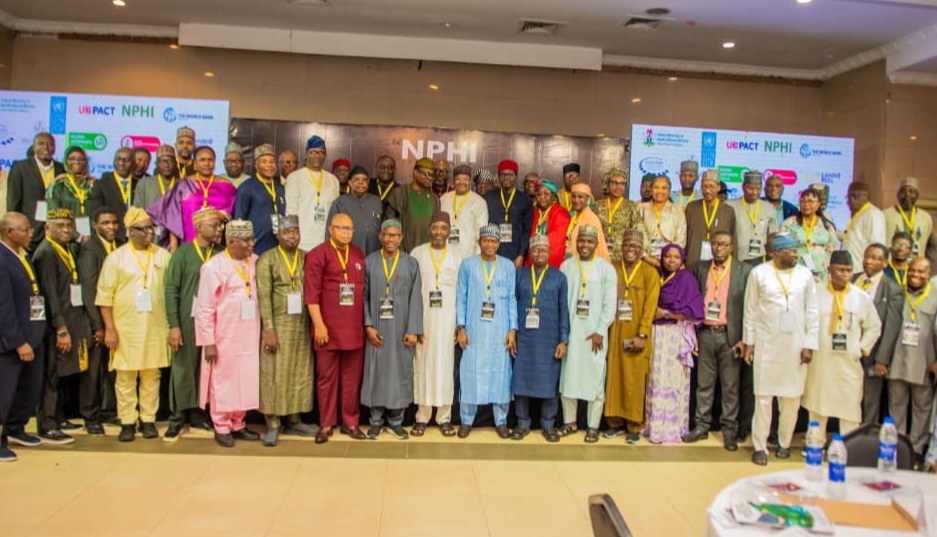
Tegbe made the call at the National Healthcare Electrification Investor Matchmaking Forum, held under the Nigeria Power for Health Initiative (NPHI) at the Lagos Civic Centre, Victoria Island. The forum was convened by the Federal Ministry of Health and Social Welfare in collaboration with UK PACT and hosted by the Minister of State for Health and Social Welfare, Dr. Iziaq Adekunle Salako. The event brought together representatives of federal and state governments, chief medical directors, development partners, and private sector leaders to explore investment opportunities in healthcare electrification.
According to a statement issued by the Deputy Director of Press and Public Relations at the Federal Ministry of Power, Clement Ezeorah, the minister commended the Federal Ministry of Health and Social Welfare for convening the engagement, noting that reliable electricity is not merely an infrastructure requirement but a fundamental pillar of effective healthcare delivery.
Tegbe disclosed that he had been actively involved in the NPHI since its inception, even before his appointment as Minister of Power. Describing the initiative as a personal commitment, he reaffirmed his support for the programme and the leadership of the Minister of State for Health.
He noted that the objectives of the NPHI align with the ongoing power sector reforms and President Bola Ahmed Tinubu’s Renewed Hope Agenda.
According to him, the initiative presents an opportunity to integrate energy planning into healthcare infrastructure development, deploy grid enhancement and renewable hybrid systems tailored to health facilities, and strengthen collaboration among power sector institutions, health authorities, regulators, and private sector stakeholders.
Highlighting the scale of the opportunity, Tegbe pointed to Nigeria’s more than 35,000 registered health facilities across primary, secondary, and tertiary levels, describing them as a substantial pipeline of bankable projects capable of attracting local and international investments.
He identified key investment areas to include solar mini-grids, hybrid energy systems, battery storage technologies, energy efficiency solutions, smart metering, facility energy management platforms, operations and maintenance services, as well as climate-resilient infrastructure.
Drawing from over three decades of experience advising governments on complex reform programmes, the minister told investors that the strength of the initiative lies not only in the ambition of its vision but also in the quality of its structure. He assured stakeholders of the Federal Government’s commitment and strong inter-ministerial coordination in driving implementation.
Tegbe further disclosed that the Federal Ministry of Power is a co-driver of the initiative and is already supporting healthcare electrification through the deployment of solar mini-grids and hybrid energy systems under the World Bank-funded Nigeria Electrification Project.
He added that the Electricity Act provides the regulatory framework for structuring Power Purchase Agreements (PPAs), licensing mini-grid operators, and enabling state-level participation in electricity markets.
Concluding his remarks, the minister said the initiative aligns with President Tinubu’s vision of positioning Nigeria as Africa’s preferred destination for quality healthcare.
He reaffirmed the government’s commitment to delivering measurable improvements in the power sector, with healthcare facilities receiving priority attention, and expressed appreciation to investors and development partners for their continued confidence in Nigeria’s future.
Speaking at the forum, the Minister of State for Health and Social Welfare, Dr. Iziaq Adekunle Salako, described the NPHI as a transformative shift from donor-funded infrastructure to a sustainable Energy-as-a-Service (EaaS) model. Under the arrangement, specialised providers finance, deploy, and maintain reliable power systems for health facilities.
According to Salako, the model is designed to address the energy poverty that continues to undermine operating theatres, cold-chain systems, diagnostic services, and emergency care across the country.
He explained that the framework is built on blended financing, institutional readiness, and national scalability. While the initiative currently targets federal tertiary hospitals, plans are underway to expand coverage across primary, secondary, and tertiary healthcare facilities nationwide through a new governance structure aimed at accelerating implementation and unlocking private-sector investment.