
Nigeria Sets to Host First National Traditional and Religious Leaders’ Summit on Health
… Unveils Major Reform Initiatives
By Raphael Ekpang
Abuja (Core Reporters) In a landmark move to strengthen community-driven healthcare delivery and accelerate national health reforms, the Federal Government of Nigeria through the ministry of health and social development has announced plans to convene the first-ever National Traditional and Religious Leaders’ Summit on Health, scheduled to hold on 15 February 2026 in Abuja.
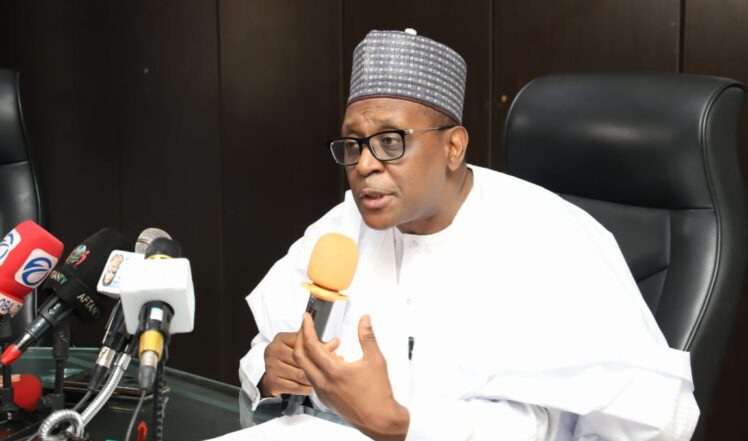
The Coordinating Minister of Health and Social Welfare, Professor Muhammad Ali Pate made this known on Wednesday, February 11, 2026, during a ministerial press briefing in Abuja, where he outlined a comprehensive strategy aimed at addressing Nigeria’s most pressing health challenges through expanded grassroots mobilisation and stronger national ownership of healthcare outcomes.
Professor Pate emphasized that government action alone cannot deliver the health outcomes Nigeria seeks, noting that public health success depends heavily on community trust, leadership, and household-level decisions.

“The health outcomes we seek cannot be driven by government action alone,” the Minister stated. “They are shaped by community trust, leadership, and everyday household decisions.”
Core Reporters report that the summit will bring together traditional rulers and religious leaders from across Northern and Southern Nigeria under one national framework to advance collective action on key health priorities, including: Maternal and child health; Tuberculosis, HIV and malaria control; Immunisation and vaccine confidence; Nutrition and primary healthcare utilisation and Epidemic preparedness and early outbreak reporting
The initiative builds on earlier successful efforts such as the Northern Traditional Leaders Committee on Primary Health Care, which played a critical role in Nigeria’s polio eradication drive beginning in 2009.
Professor Pate underscored the importance of unity in public health response, stressing that diseases do not respect religious or ethnic boundaries.
“A mosquito will go to church on Sunday and the same mosquito will go to the mosque on Friday,” he said. “Diseases do not respect religion, ethnicity or geography.”
The Minister highlighted recent progress under ongoing reforms, noting that primary healthcare utilisation has risen significantly from fewer than 10 million visits in 2023 to nearly 45 million visits by 2025, driven by improved collaboration between federal and state governments.
Under the Basic Healthcare Provision Fund (BHCPF), quarterly disbursements to primary healthcare centres have doubled from ₦300,000 to ₦600,000 per facility, enhancing drug availability, operational efficiency, and frontline health worker support.
Despite these gains, Professor Pate noted that cultural barriers, misinformation, and vaccine hesitancy continue to undermine service uptake, making community leadership engagement essential.
Nigeria–U.S. Health Financing Partnership with Transition Plan
Professor Pate also announced that Nigeria recently signed a renewed Memorandum of Understanding with the United States, covering HIV, tuberculosis and malaria programmes valued at nearly $2 billion over five years.
Importantly, the agreement includes a structured transition plan, under which U.S. financial support will gradually taper after five years as Nigeria assumes full responsibility for sustaining progress.
“We do not want Nigeria to depend on external aid in perpetuity,” the Minister said. “The health of Nigerians is the responsibility of Nigerians.”
The Federal Government projects an additional $3 billion in domestic resource mobilisation, bringing the total expected health financing envelope to approximately $5 billion over the transition period.
Notably, 10 percent of the U.S. contribution is earmarked for faith-based health facilities, reflecting the critical role of religious institutions in service delivery nationwide.
Launch of Second Cohort of National Health Fellows
The summit will also feature the unveiling of the second cohort of the National Health Fellows Programme, which recruits young professionals from all local government areas to strengthen grassroots implementation, monitoring, accountability and innovation in community health systems.
The first cohort, launched in March 2025, completed a 12-month cycle described as impact-driven and performance-focused.
Towards a People-Centred Health System
Professor Pate reaffirmed the Federal Government’s commitment to building a resilient and inclusive health system that reduces mortality, prevents financial hardship, and delivers quality care for all Nigerians.
“Our goal is to save lives, reduce financial hardship and build a system that works for all Nigerians. We are not there yet, but we are working towards it.”