
Nigeria, Philippines Strengthen Bilateral Relationship in Labour, Migration
By Raphael Ekpang
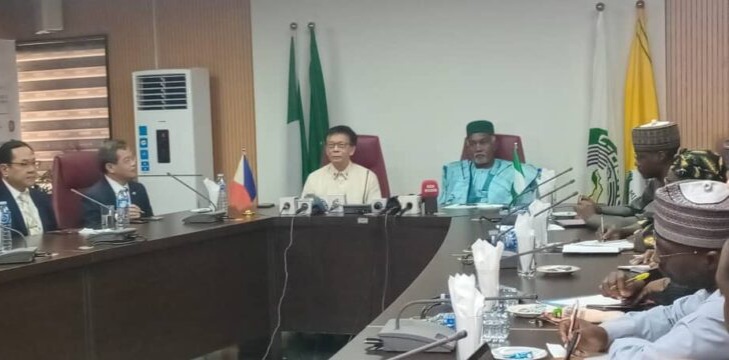
Abuja (Core Reporters) Nigeria government and the Republic of the Philippines on Wednesday, August 13, 2025 held a high-level meeting in Abuja where both countries reiterated their commitment to strengthening bilateral relations, particularly in labour and migration.
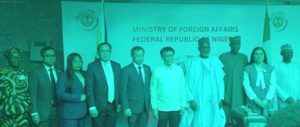
The Philippine delegation led by the Secretary of Migrant Workers, Hon. Hans Leo J. Cacdac, was received by the Minister of Foreign Affairs, Ambassador Yusuf Maitama Tuggar at the ministry headquarters in Abuja. And both parties have a strategic dialogue aimed at enhancing cooperation on labour migration, protecting migrant workers, and combating human trafficking.
Amb. Tuggar in his opening remarks expressed appreciation for the longstanding relationship between both countries, noting historical ties dating back to Nigeria’s independence. He highlighted the valuable contributions of Filipino professionals in Nigeria, particularly in the education, maritime, and aviation sectors over the decades.
“Many Nigerians of my generation were taught by Filipino teachers, especially in STEM fields. These ties extend beyond knowledge sharing, they help build cultural bridges,” Tuggar said.
He added that under President Bola Tinubu’s foreign policy agenda, anchored on Democracy, Demography, Development, and Diaspora, Nigeria is keen on learning from the Philippines’ globally recognized approach to managing overseas workers.
“We want to ensure our own diaspora workers are protected and empowered just as the Philippines does, with dignity, respect, and full government support,” the Minister stated.
The Minister also mentioned Nigeria’s Technical Aid Corps (TAC) program, established in 1987, which deploys skilled Nigerian professionals to ACP (African, Caribbean, and Pacific) countries. He hinted at plans to evolve the initiative into a revenue-generating enterprise while also seeking broader international collaboration.
Responding, Cacdac conveyed President Ferdinand Marcos Jr.’s mandate to deepen labour relations with partner countries where Overseas Filipino Workers (OFWs) are employed, including Nigeria.
“We met with some of our nationals here and are happy to see that Nigeria has been a safe and welcoming place for them,” said Cacdac. “We are here to build upon that goodwill and ensure stronger coordination and protection mechanisms.”
The Philippine delegation included high-ranking officials such as Deputy Minister for International Cooperation, John Al Rasul; Assistant Secretary for Pre-Employment Concerns, Juleen Abito; and Director for Anti-Illegal Recruitment and Human Trafficking, Giant Mendez. They were accompanied by the staff of the Philippine Embassy in Abuja.
Cacdac emphasized the importance of mutual learning between both nations in areas like migration governance, anti-trafficking efforts, and labor systems development. He also formally requested the establishment of a dedicated labor office within the Philippine Embassy in Abuja to better serve the needs of Filipino workers in Nigeria and enhance liaison with local authorities.
“Our goal is to further strengthen people-to-people ties through institutional cooperation. This includes knowledge-sharing on labor practices and building safer migration pathways for our citizens,” Cacdac noted.
Speaking to journalists after a closed-door session, Secretary Cacdac expressed gratitude to the Nigerian government for its hospitality and for fostering deeper engagement between the two nations.
“We express our profound gratitude to the Honourable Foreign Minister and to the Nigerian government and people for the warm welcome,” Secretary Cacdac said. “President Ferdinand Marcos Jr. has given us a clear directive to deepen our bilateral labor relations for the mutual benefit of both countries.”
Cacdac emphasized the Philippines’ interest in strengthening the protection of Filipino migrant workers in Nigeria, describing the country as a “safe haven” for overseas Filipino workers (OFWs). He also revealed that the Philippines is exploring the possibility of establishing a Migrant Workers Office in Abuja.
“This will help us better serve our people here and their families back home through specific programs and services,” he added.
Cacdac noted that his delegation would also meet with Nigeria’s Ministry of Labour to pursue discussions on bilateral labor arrangements, capacity building, and information exchange on labor systems and protections.
Also speaking at the event, Nigeria’s Minister of Foreign Affairs, Ambassador Tuggar, welcomed the Filipino delegation and underlined the historical ties and mutual respect between the two countries.
“It’s an honor and a pleasure to welcome Secretary Cacdac. The Philippines has long been a leader in human resource development, and many Filipinos have contributed immensely in Nigeria, especially in aviation, maritime, and education,” Tuggar stated.
Tuggar highlighted the strategic alignment of this partnership with President Bola Tinubu’s “4D” foreign policy, Democracy, Development, Demography, and Diaspora, noting that the Philippines, as a populous nation, fits into Nigeria’s demographic diplomacy.
The Foreign Minister also referred to Nigeria’s Technical Aid Corps (TAC) program, which deploys Nigerian professionals to countries across Africa, the Caribbean, and the Pacific. He said this offers a foundation for further collaboration with the Philippines, especially in areas where both countries have large youth populations and a need for skilled workers abroad.
“We want our workers to go abroad with dignity and protection. We are working on finalizing about nine pending agreements with the Philippines, and Secretary Cacdac has proposed a tenth, focusing specifically on labor,” Tuggar revealed.
During the press briefing, questions were raised about the challenges Nigerians face when seeking employment abroad, particularly around visas and diplomatic protocols.
In response, Secretary Cacdac stressed the importance of mutual information exchange to streamline procedures and improve understanding of each country’s systems.
“Our president has mandated that we ease bureaucratic processes back home, especially for foreign employment,” Cacdac explained. “We are a signatory to the UN Convention on the Protection of Migrant Workers, and we uphold the welfare of both our workers abroad and foreign workers in the Philippines.”
He reaffirmed the commitment to work closely with Nigerian authorities to ensure that both Philippine and Nigerian migrant workers are respected and protected.
The visit marks a pivotal step toward enhancing labor diplomacy between Nigeria and the Philippines. Officials from both countries have committed to continuing dialogue and formalizing agreements aimed at improving labor mobility, professional exchange, and protection for migrant workers.
Secretary Cacdac is expected to meet with Nigeria’s Minister of Labour in the coming days to further develop labor cooperation frameworks.
Core Reporters report that he meeting concluded with both sides expressing optimism about the future of Nigeria–Philippines relations, especially in areas of shared interest such as labor mobility, diaspora engagement, and human capital development.