
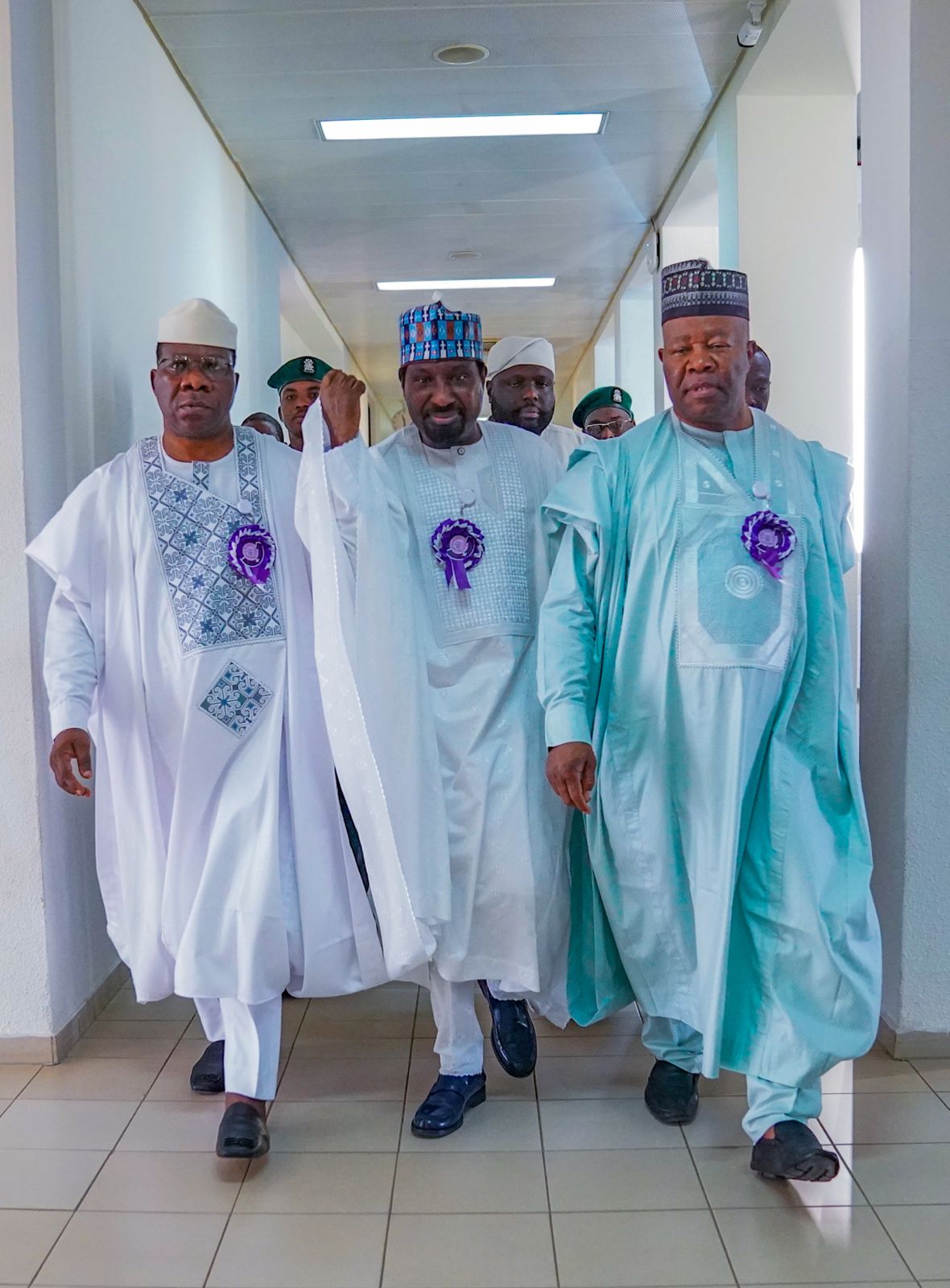
From R-L: Senate President Godswill Akpabio, Deputy Senate President Jibrin Barau, and Senate Leader Opeyemi Bamidele in international women’s day celebration mood on Thursday in national assembly complex.
By Raphael Ekpang
As Nigeria joined the world in marking this year’s international women’s day the Senate Leader, Senator Opeyemi Bamidele has said that the National Assembly is recognising that women inclusion in governance is pivotal to achieving sustainable development goals in Nigeria, adding that gender inclusiveness is at the core of the Revised Legislative Agenda of the 10th Senate.
Bamidele who joined the president of the Senate, Senator Godswill Akpabio and other colleagues in marking the International women’s day with the female Senators in the 10the Senate on Thursday raised concern over weak investment in capacity of women in Nigeria which according to him has hindered possibility of achieving fifth agenda of the Sustainable Development Goals (SDGs).
He noted that the fifth agenda of SDG is “End all forms of discrimination against all females everywhere.”
Bamidele in a statement issued by his Directorate of Media and Public Affairs in commemoration of the 2024 International Women’s Day said despite six years away to achieve bridging the gap between men and women, Nigeria is still confronted with under- representation both in the corporate and public sectors.
He further lamented about how women are victims of armed attacks in different parts of the country.
Senate Leader said that “Currently, as shown in the UNICEF statistics, Nigeria has no fewer than 18.5 million out-of-school children. More than 60% of them – approximately 10 million – are regrettably female. Also, at least 30.3% of girls in Nigeria are married before the age of 18 while 12.3% before the age of 15. Most of them are victims of armed attacks in different parts of the federation.
” As shown in recent data, women are under-represented in Nigeria’s political space. Women hold only 3.4% of federal legislative seats – four are 109 senators and 14 out of 360 members of the House of Representatives. Across all sectors, women inclusion is largely low in Nigeria whether in the corporate world or public sector.
“All these figures attest weak investment in women and eclipse the possibility of achieving the fifth agenda of the Sustainable Development Goals, which mandates the world leaders to invest in initiatives and programmes that bring about gender equality be 2030. 2030 is just six years away, and we are still confronted with ugly indices that remind us of the widening gap between men and women.
“At the National Assembly, we are conscious of the criticality of gender equality to our collective prosperity as a federation of 227 million. We also recognise that women inclusion in governance and decision-making is crucial to achieving sustainable development in Nigeria. This is at the core of the Revised Legislative Agenda of the 10th Senate, which in the main emphasises the exigency of accelerating Nigeria’s socio-economic growth through women inclusion.
“This was also a critical factor in the design and enactment of the 2024 Appropriation Act. And the legislation was structured to address critical issues undermining strategic inclusion of women in the process of decision-making, especially in business or government.”