Deprecated: Function WP_Dependencies->add_data() was called with an argument that is deprecated since version 6.9.0! IE conditional comments are ignored by all supported browsers. in /home/corerepo/public_html/wp-includes/functions.php on line 6260 FG Recovers Benin-Asaba Road Back to Ministry of Works, Reopens First Niger Bridge - Core Reporters
FG Recovers Benin-Asaba Road Back to Ministry of Works, Reopens First Niger Bridge
By Our Reporter
Abuja (Core Reporters) Nigeria’s Minister of Works, Senator Engr. David Umahi, has announced the return of the Benin-Asaba Road to the Federal Ministry of Works, disclosing that President Bola Ahmed Tinubu has directed the comprehensive redesign and full reconstruction of the 136-kilometre highway as a dual carriageway.
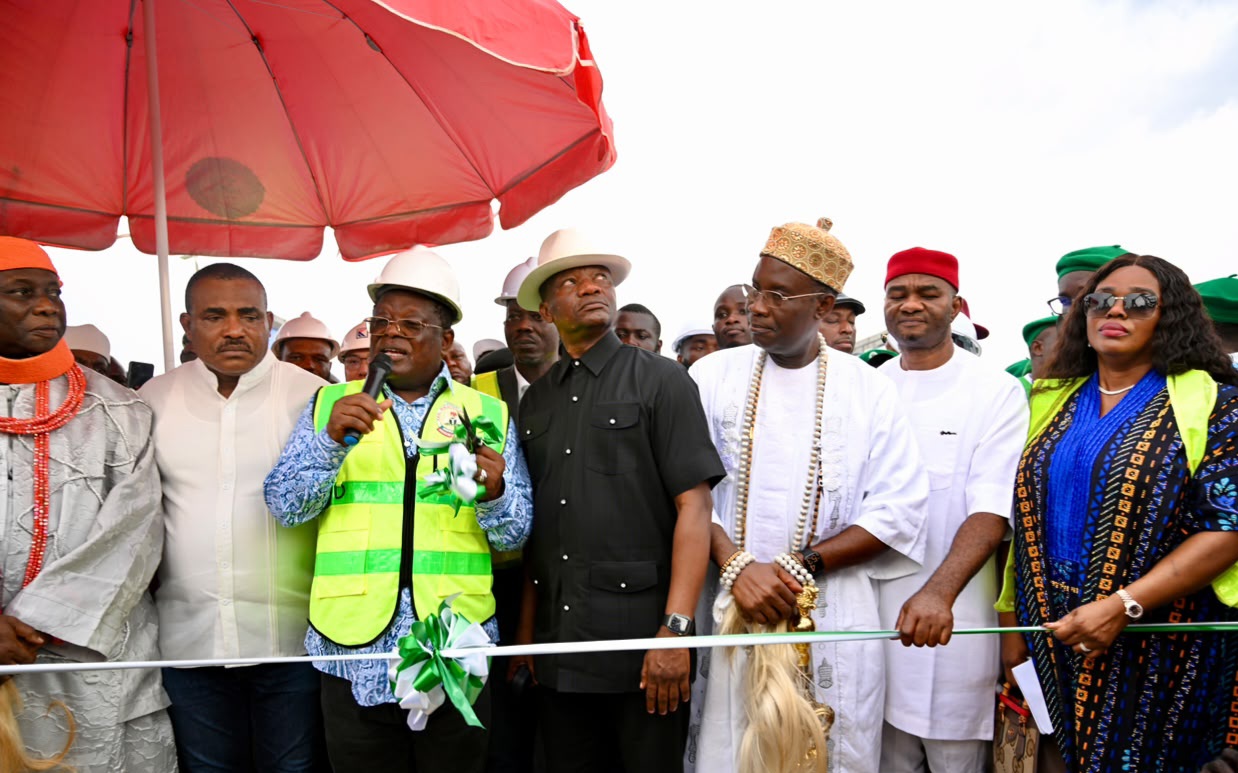
Speaking on Thursday, October 15, 2026, during the reopening of the First Niger Bridge on the Asaba-Onitsha Road, Umahi also announced remedial measures which are ongoing on critical sections of the Benin-Asaba Road, assuring motorists that permanent reinforced concrete pavement works would commence.
The Minister described the development as a major step towards resolving the longstanding challenges faced by motorists travelling between the South-South and South-East, noting that the return of the road to the Ministry of Works would enable the Federal Government to take direct responsibility for its reconstruction.
“What stopped the Ministry of Works from reconstructing Benin-Asaba Road, the concessioning of that route, has been unsealed. We now have our route back to the Ministry of Works,” Umahi declared.
He disclosed that President Tinubu had directed the total and comprehensive redesign of the 136-kilometre Benin-Asaba Road as a dual carriageway, adding that the design process was ongoing and construction would commence upon its completion.
“The legacy of President Bola Tinubu, you will see it ongoing on this road. Never again will our people suffer on this road,” Umahi assured.
The announcement came as the Minister outlined the Federal Government’s intervention to protect and rehabilitate the First Niger Bridge, a strategic transport link connecting communities and businesses across the South-East and South-South.
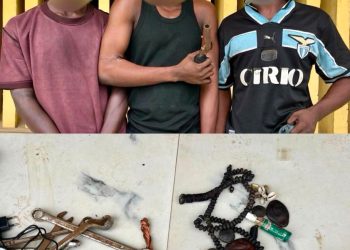
Umahi explained that the Ministry of Works responded after a content creator alerted the government to activities threatening the structural integrity of the bridge. An inspection subsequently revealed that some individuals were removing bolts and cutting iron components from the steel structure, activities he described as dangerous and capable of causing a bridge collapse.
He noted that the bridge was originally built and commissioned in 1966 by Nigeria’s then Prime Minister, Sir Abubakar Tafawa Balewa, but had suffered from inadequate maintenance over the years.
According to the Minister, the government has undertaken rehabilitation works similar to those carried out on Lagos’ Third Mainland Bridge, including asphalt resurfacing and median demarcation. He explained that the demarcation was necessary because bridges were not designed to withstand static loads indefinitely.
The ongoing safety improvements include the installation of CCTV cameras, solar-powered lighting and observation centres at both ends of the bridge. Security personnel will use the facilities to monitor activities on and beneath the structure, while three turnaround passages have been created to help motorists manoeuvre safely in the event of a vehicle breakdown.
“Exactly the treatment we gave to the Third Mainland Bridge is the treatment we gave to this place,” Umahi said, explaining that the government was applying established rehabilitation and monitoring measures to protect the bridge and improve safety for road users.
He commended the contractor, SKCC, for its work but clarified that the rehabilitation was not yet 100 per cent complete. Outstanding works include repainting the entire steel structure, completing the maintenance of rust-affected areas beneath the bridge deck, installing CCTV cameras above and below the bridge, and providing canopies at both ends.
The Minister also issued a strong warning against illegal sand dredging around bridges, reminding the directors of the Federal Ministry of Works in Delta and Anambra States that federal regulations prohibit sand dredging within a 10-kilometre radius of bridges.
He warned that disciplinary action would follow if the illegal activity continued, directing the state directors to report any failure by security agencies to enforce the regulations.
Beyond the First Niger Bridge and the Benin-Asaba Road, Umahi highlighted other major infrastructure projects across the South-East and South-South, describing them as part of President Tinubu’s wider commitment to national infrastructure development.
He disclosed that the President had directed the reconstruction of approximately 400 kilometres of the East-West Road, which traverses the Niger Delta, from the Benin axis through the South-South to Cross River State.
According to Umahi, the project would serve as a spur of the 750-kilometre Lagos-Calabar Coastal Highway, another major infrastructure project under the Tinubu administration.
“Some people thought that the East-West Road was a road in the South-East, and they started talking, trying to intentionally impinge the South-South brothers with the South-East brothers. East-West Road is entirely in the Niger Delta,” he said.
The Minister dismissed suggestions that construction on the Lagos-Calabar Coastal Highway had stopped, explaining that work remained ongoing and that the remaining sections in Bayelsa and Cross River would be taken up in the coming weeks.
He maintained that the coastal highway was a legitimate infrastructure investment for the Niger Delta and that the region was entitled to its share of national development projects.
“The coastal road is the right of the Niger Delta people. And the President will complete that 750-kilometre road. And they will also complete the SPP, which is the full reconstruction of 400 kilometres of East-West Road,” he declared.
Umahi also announced that the designs for the first and second sections of the East-West Road were nearing completion, with construction expected to commence soon.
On the Enugu-Port Harcourt corridor, he said reconstruction had reached approximately 90 per cent completion. He also highlighted the ongoing reconstruction of a 44-kilometre section in Port Harcourt using reinforced concrete pavement.
In Anambra State, the Minister announced the introduction of reinforced concrete pavement works on another major road project. He said the 107-kilometre dual carriageway project had recorded progress, with 33 kilometres completed, while work on the remaining 40-kilometre section from the First Niger Bridge axis was expected to commence within two weeks.
He also pointed to the ongoing construction of Section 2B of the Second Niger Bridge bypass, a 17.5-kilometre project valued at ₦172 billion, as another example of the Federal Government’s infrastructure investment in the region.
“These are projects that show the President’s commitment to the South-East. We cannot thank the President enough,” Umahi said, adding that the administration had deliberately integrated the region into its national infrastructure development programme.
The Minister defended the use of reinforced concrete pavement on selected highways, explaining that the approach was intended to provide durable roads capable of serving Nigerians for decades.
He illustrated the quality of the new road infrastructure with an anecdote about a pilot who reportedly mistook a newly constructed road for an aircraft runway, saying the incident is proof of the quality and smoothness of the roads being delivered.
Umahi also addressed criticism of President Tinubu’s economic reforms, arguing that the measures were necessary to prevent a deeper economic crisis and lay the foundation for long-term recovery.
“When you have a wound and you have to stitch the wound, there will be pains at the initial time, but that pain is the beginning of healing,” he said.
“The worse is over. We are now into prosperity. We are into prosperity.”
He challenged critics to provide practical alternatives to the administration’s policies rather than resort to insults and hate speech. He argued that Nigerians should assess the reforms by examining the country’s economic indicators and the direction of the economy.
“The President saved this country from catastrophic economy,” Umahi declared, maintaining that the administration had taken difficult decisions in the national interest rather than to win immediate applause.
He added that the benefits of the reforms needed to translate into improved living conditions for ordinary Nigerians, noting that the economy was moving towards the microeconomic level, where households and small businesses could begin to feel the impact.
Turning to the political debate ahead of the 2027 presidential election, Umahi explained the right of political leaders and citizens to make independent choices, rejecting suggestions that support for President Tinubu amounted to a betrayal of the South-East.
“Why is Peter Obi looking for votes in the South-West? Why is he looking for votes in the North? So people from the South-East must support only one person? When did we come together and say that all the people from the South-East will support Peter Obi?” he asked.
The Minister maintained that democracy allows citizens to make their own political decisions and urged the region to assess the Federal Government by its development projects, infrastructure investments and approach to national inclusion.
He called on political leaders, the elite and other influential voices in the South-East to educate young people about the relationship between democracy, development and infrastructure, insisting that political choices should be informed by the needs of the people rather than regional sentiments.
“Let me tell the people of the South-East, it is what you vote in January 2027 that is our right to brag. That is our right to negotiate. Let us not be very funny. Let us not be very sentimental. Let us stop the hate speeches and embrace the new wave of hope,” he said.
Umahi argued that the region’s participation in the electoral process was important to its ability to negotiate for further development and secure continued investment in roads and other critical infrastructure.
“Democracy is about development. It is about infrastructure. It is about inclusiveness. The President has done that,” he said.
“And we are here in the South-East to declare that the South-East is for President Bola Tinubu.”
The Minister concluded by describing President Tinubu as a leader whose infrastructure programme, in his view, demonstrates a commitment to national inclusion beyond ethnic and regional boundaries.
“The evidence of what we are doing today is a total testimony that President Bola Tinubu is a detribalised Nigerian,” Umahi said.