

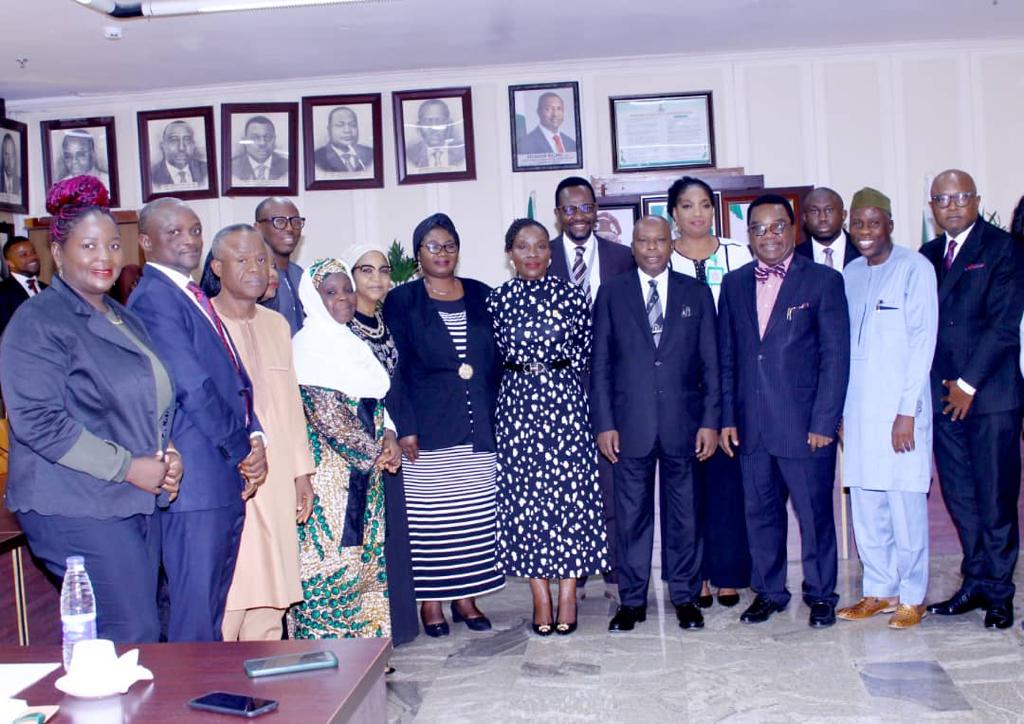

…As Commission seeks support of AGF to boost their work.
By Raphael Ekpang
The Federal Government has expressed readiness to support the National Human Rights Commission (NHRC) to ensure peace, stability and the respect for and human rights in the country.
Attorney General of the Federation (AGF) and Minister of Justice, Mr. Lateef Fagbemi gave the assurance on Wednesday when the Executive Secretary of NHRC Dr. Tony Ojukwu (SAN) led the Commission’s management team on a courtesy visit to the former.
Fagbemi said that the present administration of Bola Ahmed Tinubu has prioritized the NHRC as an institution that could ensure peace, stability and the respect for and human rights in the country.
He acknowledged the financial hardships confronting the Commission urging for patience while the government addresses their needs, particularly with respect to acquiring vehicles.
The Hon.Minister expressed his satisfaction with the Commission’s independence and its commendable commitment to non-interference from the government and other bodies.
Earlier, the NHRC’s scribe Dr. Ojukwu has sought the support of the federal government to strengthen the Commission’s efforts in the promotion, protection and enforcement of human rights in Nigeria.
Dr. Ojukwu, however, provided a comprehensive overview of the NHRC’s history, mandate, functions, powers, organizational structure, and management since its inception. He discussed the Commission’s growth, the challenges it has faced, and its struggle for independence in recent years.
The Chief Executive Officer of the NHRC emphasized the Commission’s role in holding government accountable for policies and laws that promote human rights while mitigating human rights violations in the country. He highlighted several key issues in the Commission as follows:
Governing Council Appointments: The Human Rights Boss stressed the need for the appointment and removal of governing council members to be of paramount importance, with consideration given to the tenures of office of members of the Council.
Also, Financial Constraints: Dr. Ojukwu lamented that the Commission faces significant financial constraints which can hinder its operational independence if not adequately addressed. “Lack of transportation for state offices to carry out investigations and inadequate equipment/infrastructure to work with, are few examples” he added.
Staffing Challenges: The Chief Human Rights Officer of Nigeria expressed concerns about its 13 departments, 36 state offices, and a staff strength of 900 individuals. He recalled that a high weekly resignation of staff has posed a major challenge to the Commission, leading to a need to recruit more staff to strengthen the state offices.
Budgetary Allocations: According to the Executive Secretary, Commission’s limited budgetary allocations significantly impact its ability to handle a minimum of 2 million complaints per annum. He said the absence of a funded Human Rights fund by the federal, state, or local governments has been a long-standing concern since 2010.
Meanwhile, despite these challenges, Dr. Ojukwu also highlighted some significant achievements, including the thorough investigation and resolution of 1,640,018 complaints. Notable compensations include 350 million naira to the families of eight victims of the APO killings (Okada riders) by the Department of State Services in 2013 and 450 million naira in compensation paid to victims of the END SARS protests by the Commission.
.