Deprecated: Function WP_Dependencies->add_data() was called with an argument that is deprecated since version 6.9.0! IE conditional comments are ignored by all supported browsers. in /home/corerepo/public_html/wp-includes/functions.php on line 6260 JAR 2026: Nigeria Records Major Health Sector Gains as Insurance Coverage Hits 24 Million – Pate - Core Reporters
JAR 2026: Nigeria Records Major Health Sector Gains as Insurance Coverage Hits 24 Million – Pate
By Our Health Correspondent
Abuja (Core Reporters) The Federal Government has announced the achievement of all 41 presidential commitments in the health sector, recording significant progress in healthcare delivery, financing, infrastructure, local manufacturing and national health security under President Bola Ahmed Tinubu’s administration.
The Coordinating Minister of Health and Social Welfare, Professor Muhammad Ali Pate, disclosed this on Monday at the Third Nigeria Health Sector Joint Annual Review (JAR), held at the Transcorp Event Centre, Abuja, with the theme, “Together to Higher Grounds.”
Pate attributed the achievements to the administration’s commitment to implementing the Nigeria Health Sector Renewal Investment Initiative and the Health Sector Strategic Blueprint.
He explained that the reforms, implemented through the Sector-Wide Approach (SWAp), were strengthening governance, accountability and coordination across the three tiers of government.
The minister highlighted the adoption of a unified framework built around One Plan, One Budget, One Report, One Conversation and One Voice, involving federal and state governments, local governments and development partners.
On healthcare financing, Pate disclosed that cumulative releases under the Basic Health Care Provision Fund (BHCPF) had reached approximately ₦422.3 billion as of October 2026.
He added that 3,526 primary healthcare centres had been revitalised, with work ongoing on another 900 facilities, while more than 8,000 BHCPF-supported facilities continued to benefit from the initiative.
On maternal and newborn health, the minister revealed that 19,758 skilled birth attendants had been recruited across 22 states, while 4,747 community health workers had been engaged in 10 states and 78,054 frontline health workers trained.
He said the Maternal and Newborn Mortality Reduction Innovation Initiative (MAMII) had increased the proportion of participating BHCPF facilities with at least two midwives or community health extension workers from 12 per cent to 91 per cent.
According to him, 750,000 pregnant women had also been mapped to functional health facilities, while emergency transport services had conveyed 104,566 women and newborns.
Pate further reported improvements in essential health services, noting that skilled deliveries in BHCPF facilities increased from 4.8 million in 2023 to 7.9 million by the end of the second quarter of 2026.
He said fourth antenatal care visits rose from six million to 8.7 million, while outpatient attendance increased to 43 million.
The minister also disclosed that more than 17 million adolescent girls had received the Human Papillomavirus (HPV) vaccine, while measles and rubella vaccination had reached 100 million children.
On financial protection, Pate said health insurance coverage had increased from approximately 16 million to nearly 24 million Nigerians within three years.
He added that 5,106 patients had benefited from up to 80 per cent reduction in dialysis costs, while 710 cancer patients received an 80 per cent subsidy on selected cancer medicines.
The free 48-hour emergency care programme, he noted, had also benefited more than 15,000 Nigerians across 507 empanelled health facilities.
On local pharmaceutical and medical manufacturing, the coordinating minister disclosed that 10 factories or manufacturing lines had been commissioned, including six in 2026, covering pharmaceuticals, rapid diagnostic tests, insecticide-treated nets and medical oxygen.
He further stated that the Presidential Executive Order on healthcare manufacturing had facilitated ₦24 billion in tax waivers for pharmaceutical manufacturers, alongside 12 technology-transfer agreements and a prospective investment pipeline exceeding $5 billion.
Addressing national health security, Pate cited Nigeria’s successful management of an imported Ebola case as evidence of improved preparedness, surveillance and emergency response.
He commended the Nigeria Centre for Disease Control and Prevention (NCDC), port health teams and development partners for their contributions to strengthening the country’s response capacity.
The minister, however, acknowledged persistent challenges relating to stunting, healthcare affordability, quality of care and patient satisfaction, even as the 2026 review recorded improvements in 12 of the 13 health indicators assessed.
Looking ahead, he identified increased domestic health financing, equitable distribution of health workers, modernisation of federal tertiary hospitals, expanded health insurance coverage and accelerated digital transformation as key priorities.
He urged stakeholders to sustain collaboration, address implementation gaps and strengthen accountability, stressing that the ultimate measure of the reforms must be improved health outcomes and a better quality of life for Nigerians.
Pate expressed appreciation to President Tinubu for his leadership and commended health workers and development partners for their contributions to the ongoing transformation of the health sector.
Earlier, the Minister of State for Health and Social Welfare, Dr Iziaq Adekunle Salako, said the Tinubu administration had recorded substantial progress across the eight health priority areas of the Renewed Hope Agenda, with key performance indicators scoring between 60 and 92 per cent.
He said the areas covered governance, health security, local production, health financing, primary and secondary healthcare, health workforce, mental health, equity, quality and preventive care.
Salako explained that the 2026 Joint Annual Review would assess progress in reproductive, maternal, newborn, child and adolescent health, food and drug regulation, emergency medical transport, free maternal and newborn services, MAMII, nutrition, non-communicable diseases, local manufacturing and health security.
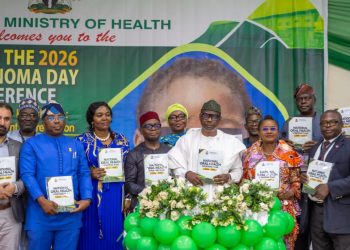
He added that the review would feature the launch of key policy documents and reports, including the Mini-Demographic and Health Survey (Mini-DHS), the National Sexual and Reproductive Health Policy 2026–2030, and the Task-Shifting and Task-Sharing Guidelines.
Describing 2027 as a critical year for consolidating the ongoing reforms, Salako urged stakeholders to ensure that the review produced clear and actionable resolutions, with assigned responsibilities and timelines for integration into the 2027 annual operational plans.
In her welcome remarks, the Permanent Secretary of the Federal Ministry of Health and Social Welfare, Daju Kachollom S. mni, described the Joint Annual Review as a critical accountability and performance assessment platform for evaluating progress, identifying implementation gaps and defining priorities for accelerating the Nigeria Health Sector Renewal and Investment Initiative (NHSRII).
She disclosed that the ministry had strengthened stakeholder participation in the Health Sector Renewal Compact through the inclusion of the Association of Local Governments of Nigeria (ALGON), private-sector actors, traditional rulers and faith-based institutions.
According to her, Joint Annual Reviews had been conducted across all 36 states and the Federal Capital Territory, reinforcing the principle of One Plan, One Budget, One Report, One Conversation.
Kachollom urged stakeholders to translate policy commitments and investments into measurable improvements in healthcare delivery, emphasising the need for stronger institutional capacity, efficient resource utilisation, effective monitoring mechanisms and mutual accountability at national and subnational levels.
She reaffirmed the ministry’s commitment to building a resilient, equitable and responsive health system capable of delivering quality, accessible and affordable healthcare to all Nigerians.
The Permanent Secretary also called for renewed collaboration towards achieving Universal Health Coverage and improved population health outcomes.