Deprecated: Function WP_Dependencies->add_data() was called with an argument that is deprecated since version 6.9.0! IE conditional comments are ignored by all supported browsers. in /home/corerepo/public_html/wp-includes/functions.php on line 6260 2027: APC Inaugurates Presidential Campaign Team as Yilwatda Warns Against Complacency - Core Reporters
2027: APC Inaugurates Presidential Campaign Team as Yilwatda Warns Against Complacency
By Raphael Ekpang
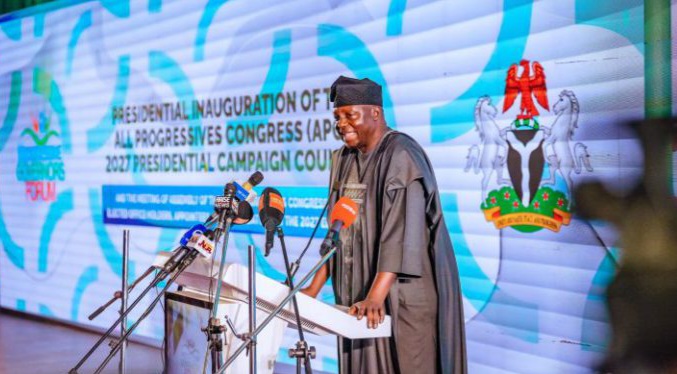
Abuja (Core Reporters) – The All Progressives Congress (APC) has inaugurated its Presidential Campaign Council for the 2027 general election, with National Chairman, Prof. Nentawe Yilwatda, urging members to translate the party’s extensive political structures and President Bola Tinubu’s economic reform programme into tangible electoral gains.
Speaking at the inauguration ceremony at the Presidential Villa in Abuja on Wednesday, Yilwatda cautioned party members against complacency, stressing that electoral confidence must be backed by strategic planning, effective communication, public engagement and demonstrable results.
He said the APC’s nationwide structure, comprising more than 261,000 party executives and supported by 31 governors, provided a formidable platform for mobilisation ahead of the January 16, 2027 presidential election.
However, the national chairman emphasised that the party’s organisational strength alone would not guarantee victory, insisting that its campaign must convince Nigerians that the administration’s policies are delivering results and offer a credible path towards economic recovery and improved living standards.
With the presidential election approaching, the ruling party faces the task of consolidating its political structures, communicating its achievements and addressing public concerns over the cost of living, insecurity, unemployment and access to essential services.
Yilwatda described the APC’s network across national, state, local government and ward levels as a major organisational advantage, urging governors, legislators, state party chapters, local government leaders and ward executives to work as a coordinated campaign machinery.
He said the party must ensure that its message reaches communities across the federation through sustained engagement rather than relying solely on political rallies and public declarations.
For the APC, the challenge extends beyond publicising the administration’s achievements. The campaign must demonstrate how government policies affect household spending, business operations, employment opportunities and the security of citizens.
Reforms Must Translate into Tangible Benefits
Yilwatda identified economic reforms and investments in roads, electricity, gas, railways, ports, agricultural infrastructure and digital connectivity as key components of Tinubu’s record, urging the campaign council to explain their contributions to productivity, employment, commerce and national development.
“Our responsibility is to explain what has been achieved, what is progressing and what remains to be done,” Yilwatda said.
His remarks placed the practical impact of government policies at the centre of the re-election campaign, acknowledging that voters would assess the administration not merely by its policy announcements but by the improvements they experience in their daily lives.
For households, these include more affordable food, reduced transportation costs and improved purchasing power. Businesses, meanwhile, will be looking for reliable electricity, access to finance, lower operating costs and stronger consumer demand.
Security, healthcare, education and agricultural productivity are also likely to shape public perceptions of the administration as the election approaches.
The national chairman urged the campaign council to address these concerns directly rather than depend on broad claims of progress.
Although he highlighted several areas of government investment, he did not present a consolidated set of figures showing their impact on employment, household incomes or business productivity.
Demonstrating measurable benefits from the administration’s policies will therefore be critical to the APC’s efforts to persuade voters that the reforms justify another four-year mandate.
Yilwatda also urged the campaign council to combine the administration’s achievements with an honest assessment of its shortcomings and a credible vision for the future.
The approach recognises the political risks of a campaign that celebrates government policies without adequately addressing the economic difficulties and other challenges confronting citizens.
The APC intends to defend Tinubu’s reform programme by explaining its objectives, presenting evidence of progress and outlining measures to address outstanding challenges.
However, opposition parties are expected to scrutinise the administration’s handling of the economy and security, making the credibility of the ruling party’s campaign message particularly important.
For the APC, the task is to demonstrate not only that policies have been introduced but also that they are producing measurable benefits and that the government has a credible plan to resolve persistent problems.
Women, Youths, Persons with Disabilities in Focus
Yilwatda called for meaningful participation by women, young people and persons with disabilities, describing them as essential to the party’s organisational strength and democratic engagement.
He urged the APC to regard young Nigerians as partners in shaping the country’s future rather than merely as participants to be mobilised during election campaigns.
He also emphasised the need to provide persons with disabilities with accessible and inclusive opportunities to participate in the democratic process.
However, he did not announce specific numerical targets for representation or measurable benchmarks for participation, leaving the implementation of these commitments to the campaign council and relevant party structures.
The effectiveness of the initiative will depend on whether the party translates its assurances into practical campaign roles, inclusive engagement and accessible outreach programmes.
Campaign Leadership and Strategy
The APC national chairman called for issue-based and peaceful political engagement, acknowledging the legitimate role of opposition parties in a democratic society.
He said the party would defend its record with facts and allow Nigerians to make their choices through a credible electoral process.
Yilwatda added that the party’s National Working Committee (NWC) would work closely with the Presidential Campaign Council and other party structures to coordinate campaign activities nationwide.
The council was constituted with President Tinubu as chairman, Vice-President Kashim Shettima as first vice-chairman and Yilwatda as second vice-chairman.
Former Zamfara State Governor Abdulaziz Yari was named Director-General, while Imo State Governor Hope Uzodimma was appointed secretary.
The leadership structure places the president and other senior party figures at the centre of the re-election campaign, with state-level and grassroots organisations expected to drive mobilisation across the country.
Yilwatda concluded by calling for unity, discipline and sustained commitment, stressing that the party had a record to defend, a vision to communicate and public confidence to earn.
As the APC prepares for the 2027 presidential election, its extensive political network provides an organisational advantage. However, the ultimate test will be whether the party can convert that structure into genuine voter support.
With more than 261,000 party executives cited as part of its mobilisation strength, the ruling party has a formidable platform for reaching voters. Whether that machinery can secure another mandate for Tinubu will depend significantly on the credibility of its message, the evidence it presents and the extent to which Nigerians believe the administration’s policies are improving their lives.