

2025 World Sight Day: Nigeria Takes a Step Towards Accessible Eye Care: Integrating Primary Eye Care into PHC System
Abuja (Core Reporters) Nigeria government, through the Federal Ministry of Health and Social Welfare has reiterated its commitment to preventing avoidable blindness and improving access to quality eye care services across Nigeria through the integration of Primary Eye Care (PEC) into the nation’s Primary Health Care (PHC) system.
Minister of State for Health, Dr. Iziaq Adekunle Salako, stated this in Abuja, Thursday 9 October 2025 during the commemoration of the 2025 World Sight Day, themed “Love Your Eyes.”
Represented by Dr. Jimoh Olawale Salaudeen, mni, Director of Hospital Services Department in the Ministry, said the initiative aims to make eye care accessible to millions of Nigerians, particularly those in underserved and rural communities.
He noted that vision plays a crucial role in socio-economic development, stressing that eye health is now recognized as part of the United Nations Sustainable Development Goals (SDGs) following Nigeria’s adoption of the “Vision for Everyone” resolution at the UN General Assembly.
“Evidence has shown that individuals with impaired vision have difficulty performing daily tasks and their productivity declines significantly,” Dr. Salako said. “The avoidance of blindness is key to achieving SDG 1, No Poverty,because vision loss costs the globe an estimated $411 billion annually.”
He highlighted that Nigeria’s National Eye Health Policy (2019) and the National Eye Health Strategic Development Plan (2023–2027) provide the framework for scaling up eye care delivery and strengthening the nation’s health system toward universal coverage.
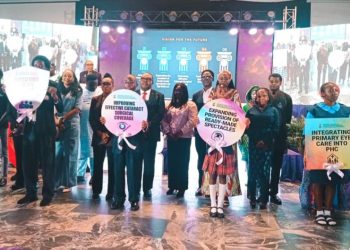
According to Salako, to ensure widespread impact, the ministry has trained 12 master trainers across Nigeria’s six geopolitical zones to further train state-level personnel on the integration of PEC into PHC. Data collection and reporting tools for PHC facilities have also been developed to enhance monitoring and evaluation.
The minister explained that this integration would empower primary health care workers to manage simple eye conditions and refer complex cases appropriately, thereby improving early diagnosis and reducing avoidable vision loss.
On ongoing interventions, Dr. Salako announced the rollout of the Effective Spectacle Coverage Initiative Nigeria (ESCIN), also known as Jigibola 2.0, which aims to distribute five million free reading glasses across 15 states within three years. The initiative targets uncorrected refractive errors, particularly presbyopia, a common cause of visual impairment in older adults.
“By prioritizing eye health today, we are investing in a brighter, more prosperous tomorrow for Nigeria,” he added.
In her welcome address, Permanent Secretary Federal Ministry of Health and Social Welfare, Daju Kachollom mni, represented by Dr. Oteri Okolo Eme National Coordinator of the National Eye, Ear and Sensory Functions Health Programme NESHP, urged Nigerians to embrace regular eye check-ups and early detection of eye diseases.
She emphasized that eye health is not only a medical concern but also central to achieving universal health coverage and driving national development.
“The economic and social implications of vision impairment are enormous, especially for a young and growing population like Nigeria’s. We must act now to prevent avoidable blindness and improve quality of life,” she said.
In her presentation titled “Celebrating the Impact of Partnerships in Putting Patients at the Heart of Eye Health,” Dr. Oteri Okolo Eme, National Coordinator NESHP, highlighted the country’s journey and progress in advancing eye health, describing it as a steady climb “up a mountain once shrouded in mist.”
Dr. Eme likened Nigeria’s eye health progress to a determined expedition, one that has endured challenges of limited resources and data gaps but continues to gain momentum through collaboration and innovation.
“Our journey began with modest resources and daunting statistics, but with leadership, partnerships, and donor support, we have scaled steep terrain,” she said. “We now have policy documents and governance structures in 35 states and the FCT, and we hope to achieve full nationwide coverage by next year.”
She explained that the NESHP, which has recently expanded its mandate to include ear and sensory functions health, has engaged state and community structures to strengthen advocacy, improve service delivery, and ensure community ownership of interventions.
Among the notable achievements outlined were: The Effective Spectacle Coverage Initiative Nigeria (ESCIN), JigiBola 2.0, has dispensed over 1.2 million free pairs of reading glasses within one year, with 66% of beneficiaries receiving their first pair and over half being women.
The training of about 2,200 Primary Health Care Workers across 15 states to deliver primary eye care, strengthening referral systems from primary to tertiary levels.
3,000 free cataract surgeries for Nigerians in riverine communities, already underway this year. Ongoing supportive supervisory visits to 10 states for gap analysis to improve implementation and ensure skill retention in primary eye care delivery.
Despite the strides, Dr. Eme acknowledged persistent challenges such as inadequate policy architecture, resource gaps, and insufficient data for planning. She emphasized that these findings would guide future strategies for stronger eye health governance.
“We are not yet at the summit, but we can see the clouds,” she said. “With every step, we’re closer to a Nigeria where no one is needlessly blind, and those with irreversible vision loss can still contribute meaningfully to national development.”
Dr. Eme also highlighted collaborations with global partners including the Livelihood Impact Fund, International Agency for the Prevention of Blindness (IAPB), Ariadne Labs at Harvard T.H. Chan School of Public Health, and the International Eye Care Centre at the London School of Hygiene and Tropical Medicine, which have fostered knowledge exchange, capacity building, and innovative solutions.